22.12.15

Venice/Venecia 2 in Italy/Italia in winter Corina Moscovich

During my second day in Venice I took about 50 pictures without counting some silly “selfies” that I´m not going to publish anywhere. There is so much history, there are so many references. And churches. And “campos”, and all sorts of streets with different denominations... 


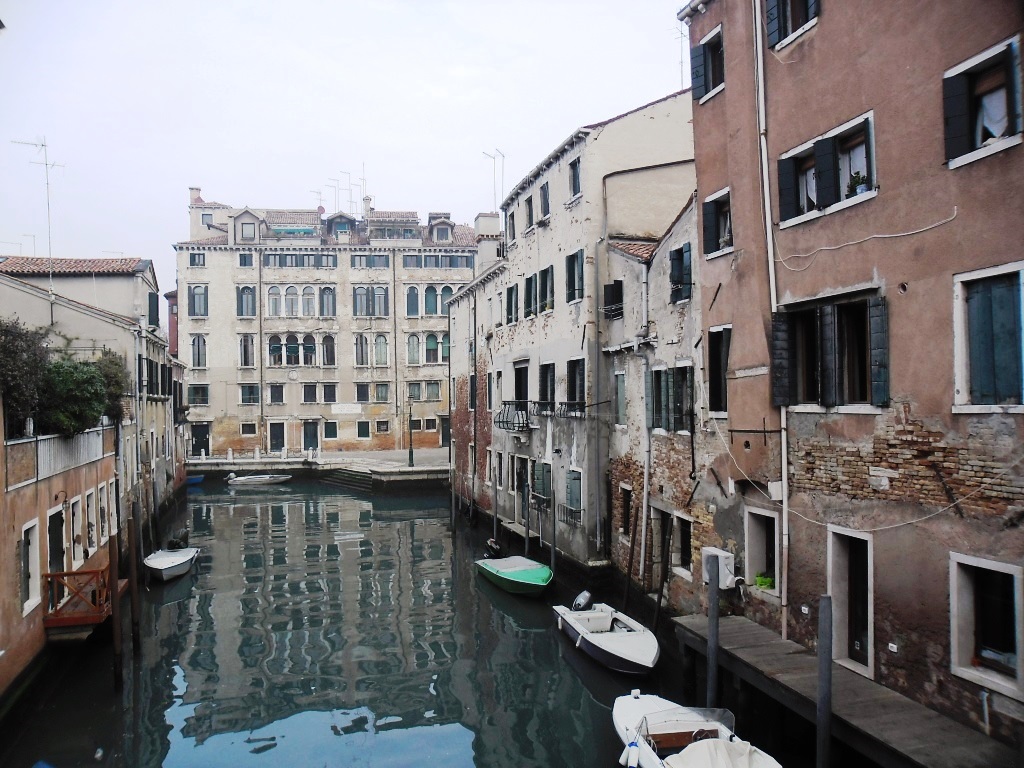
This post is mainly about the “instantáneas” -as we say in Spanish- of what Venice is about. This city is really unique. It´s a labyrinth of houses in the shade of orange, light and dark brown. 


Linguistic landscaping: sale clothing near the train station 


Food offer is gigantic. Prices vary a bit but not a lot. Tempting shopping windows.
I don´t like Eros Ramazzotti, but it was funny to see this "Italian icon" here in Venice.


 Multicultural Venice: people from everywhere selling fruits and veggies. 

Thinking about my artist friend Ma. Laura Rolle


¿Qué pasa gondoliers?


¿Qué pasa gondoliers?


 The colour of the water is different according to the time of the day and it doesn´t really smell. However, some streets smell to cats´ pee and there is dog´s poo here and there. Enough with the nasty comments, but it´s part of the city as well. There are many shops where you buy stuff for pets (food, toys, etc). 


Soccer... passion... sounds familiar.
People are super nice, it doesn´t matter how bad you speak Italian: your effort is always rewarded. Now, whenever I say: Io sono argentina, I get positive feedback. Earlier today, an old nice man told me something like "half of Argentina is Italian". I just smiled as it is a bit more complex than that. Although I definitely do not have roots from here, there is this crazy familiarity every time I step the wonderful land of Italy. I feel I understand Argentinian mentality a bit better. I see a mirror reflecting similar cultures.

Next: Burano Island.

21.12.15

Venice/Venecia- Italy/Italia in winter Corina Moscovich

To leave from Luxembourg (Findel airport) made my trip much easier and KLM has nothing to do with Ryan Air. Customer service was great before flying. Same with flying attendants. 
Yummy cake inside the cuttest KLM box. And orange juice. Great match.
The two flights (first one to Schipol Airport, in Amsterdam and the second one from there to Venice) have been great and punctual. 
 Venice has welcomed me back with a sunny day and a blue sky. Couchsurfing is always -somehow- part of my trips.
I´m staying at DorsoDuro district.
  
Venice seduces me. I walk through the narrow streets, cross bridges here and there, listen to Italians (impossible not to), smell true pizza...
 I am finding my way to avoid crowded places. It is not easy, but taking less "on the map" spots, helps a lot.
 I am enjoying, trying-trying-trying not to think too much.
 I watch and listen to people from everywhere, I see details that I only comment to myself because time goes on so fast...
 I walk and walk and walk until it's way too cold or too humid.
  The blue sky from the morning turned into a densely foggy afternoon.

 
Do you want to read about my first time in Venice? http://corinamoscovich.blogspot.it/2013/01/e-14-venecia-italia-y-alrededores.html
 

“Sometimes we need the fog to remind ourselves that all of life is not black and white.” Jonathan Lockwood Huie


  “Living without faith is like driving in a fog.” (Proverb)

19.9.15

A bit about multilingualism and multiculturalism. Corina Moscovich

First semester is over... 
Different moments came to my mind, not just inside Uni; but for example waiting for the train with my colleagues. One time, someone started asking to the rest: How do you greet people in your country? How many kisses do you give when you great someone? And the answers were so interesting that I wanted to record them somehow. There we were, coming out of a class from a Master in Multilingualism and Multiculturalism and right there, we had reality.
I always explain to my friends and my family that I learn not just from the professors and the theory, but from my colleagues. I really enjoy spending time with them, asking or answering questions, sharing experiences, ways of teaching/learning.
That day at the train stop, I learnt about kisses and hugs being given for special occasions such as birthdays or farewells. I also learnt that my colleague from Japan did not greet his mother with a kiss before departing to Luxembourg, because they do not kiss each other.
One time, in a group we share on FB, someone posted: “We all know how dogs bark but how is it "translated" in your language?” Immediately people started talking about dog barking and how to say it in different languages. Although we knew that animals have different sounds in different languages, our answers really surprised us all: ham-ham in Romanian, waf or woef in Dutch, how how in Arabic, bau-bau in Bulgarian, Haf haf in Armenian, Wuff-Wuff in German, wan-wan in Japanese, hau hau in Slovak and in Polish, guau guau in Spanish, Bow bow in Hindi and in few other Indian languages. We were astonished to discover that gav-gav is used in Greek, Russian and Ukrainian and that Au au is used in Portuguese as well as Lithuanian.
Then, the conversation switched to proverbs about dogs and we discovered that a barking dog doesn´t bite was the same in mostly all the languages the debate included: "Perro que ladra no muerde", “Το σκυλί που γαυγίζει δεν δαγκώνει”, "cão que ladra não morde", “Căinele care latră, nu muşcă”, etc. This debate was very enriching as it showed us how through a simple question we can all help to provide data and then, compare the results.
For me, multilingualism always plays a good value. Multilingualism generally implies multiculturalism, as language is culture. Or, languages are cultures. 
Corina Moscovich

Studying and teaching in multilingual universities. Corina Moscovich

In order to write this post, I started from global to particular. First I made a list of the 11 courses I took during the 1st semester at the University of Luxembourg. Afterwards, I thought about the languages used for teaching and communicating: English, French, and German.
I was a little bit shocked to find out that, having started a Master in Learning and Communication in Multilingual and Multicultural contexts; we (students and professors) used mainly English in six of those 11 subjects: Introduction to discourse analysis (J. W.), Promoting childhood bilingualism (C. K.), Becoming a Researcher (M. B.), Linguistic Landscaping (K. J.), Digital Technologies, Identity and Migration (F. D.) and Multilingualism, Creativity and Innovation in International Business Settings (P. S.).
My surprise was strengthened when I reflected about French: Prof. V. M. used it mainly in her intensive three-day course of Communication plurilingue et dynamiques de participation au travail while Prof. I. de S.-G. and G. B. intensely used it only at the beginning of Introduction à l’ethnographie and Langage et education respectively.
But when it came to German, I inevitably I thought about how Prof. A. H. was the only one who made use of German, French and English in order to teach Studying and teaching in multilingual universities. Focusing now only in the language aspect, this class was the only academic space, besides the German course itself, where I felt the input to keep on studying that language.
 At last but not least, I focused my attention on the course of German (A1 level), where the two teachers from a private institute from the city, C. B. and M. S., did not use other languages, with the exception of some words.
Precisely, the balance of all the languages (mother tongues) helped us, students, to understand words without necessarily having to translate them into English. E.g.: The teacher said tisch and then, one of us said the same word in another language, and we all started like a “chain of meanings” until we understood it.
We were 18 students (prospective students of diverse masters) from different backgrounds, ages and countries (Japan, Bulgaria, Cameroon, India, Luxembourg, Greek, Portugal, Turkey, Rumania, Poland, Egypt and Norway). Most of us had arrived only some days before starting that class; we did not know each other, or the classrooms, or the teachers, etc.
After two intense weeks of studying German for about 5 hours per day, we sat for the first exam at the University of Luxembourg. That was definitely an experience that made the group feel more connected. 70 days later, we got mostly positive results of our tests.
And more importantly, from those 18 students, many of us will keep studying German.
Corina Moscovich